


📌 Core Essence: Sacred mysteries and ancient gnosis encompass the preserved scientific, astronomical, and metaphysical knowledge of advanced pre-flood civilizations. Shattered by the Younger Dryas cataclysms roughly 12,800 years ago, this antediluvian heritage survived through megalithic acoustic architecture, symbolic temple complexes like Göbekli Tepe, and secret initiatory lineages worldwide.
Table of Contents
- The Younger Dryas Boundary and the Cataclysmic Amnesia of Humanity
- Göbekli Tepe and Karahan Tepe: The Deliberately Buried Star Temple Complexes
- Acoustic Engineering and Sacred Architecture in Predynastic Egypt
- The Lineage of the Custodians: How Sacred Gnosis Survived the Deluge
- Frequently Asked Questions About Ancient Mysteries and Gnosis
- Conclusion: Reclaiming the Memory of Our Lost Greatness
Orthodox historical academia operates under a dogmatic linear conceit: the unproven assumption that human civilization progressed smoothly from primitive cave-dwelling hunter-gatherers, through simplistic agrarian villages, into the apex of modern technological mastery.
This comfortable paradigm is collapsing under the sheer physical weight of global archaeological and geological anomalies.
Across every continent, massive cyclopean stone structures defy orthodox timelines. Precision-cut multi-ton diorite blocks fit together with microscopic tolerances. Subterranean megalithic sanctuaries align with astronomical precession across millennia. Global flood mythologies and antediluvian king lists describe an identical epoch of high civilizational achievement shattered by cosmic fire and water.
Humanity is not a species enjoying a steady ascent from savagery. Humanity is a species suffering from profound amnesia.
Between 12,800 and 11,600 years ago, our planet suffered a series of catastrophic impacts that annihilated a sophisticated global maritime culture. The remnants of their operational sciences—sacred geometry, acoustic engineering, archaeoastronomy, and inner alchemical transmutation—were codified into temple architectures, mythological allegories, and esoteric mystery schools.
To explore sacred mysteries and ancient gnosis is not to indulge in idle fantasy. It is a forensic investigation into our forgotten heritage, recovering the architectural technologies that allow consciousness to master its reality.
The Younger Dryas Boundary and the Cataclysmic Amnesia of Humanity
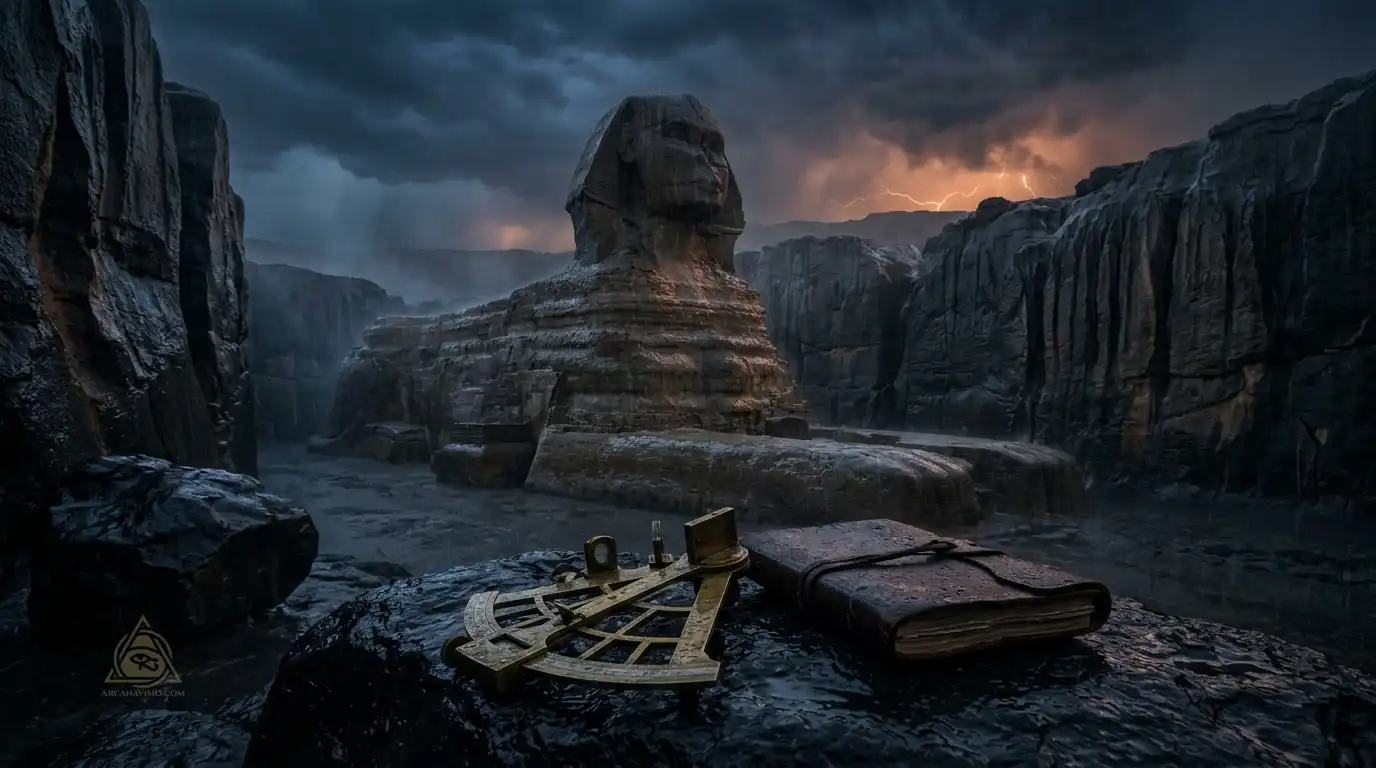
In his philosophical dialogues Timaeus and Critias, Greek philosopher Plato recorded an extraordinary historical account passed down from the Athenian lawmaker Solon. Around 600 BCE, Solon traveled to the temple city of Sais in the Nile Delta to confer with the elder Egyptian priesthood.
Observing Solon’s attempts to trace Greek genealogy back to mythological origins, an elderly Egyptian priest famously interrupted him: “O Solon, Solon, you Hellenes are but children… There is no old opinion handed down among you by ancient tradition, nor any science that is hoary with age. There have been, and will be again, many destructions of mankind arising out of many causes; the greatest by fire and water.”
The priest informed Solon that roughly 9,000 years prior to their conversation—placing the event around 9600 BCE—a cataclysm of planetary proportions destroyed an advanced maritime empire known as Atlantis beneath catastrophic oceanic inundations.
For generations, mainstream historians dismissed Plato’s account as an invented political allegory. Today, modern paleoclimatology and geology have validated Plato’s exact timeline with forensic precision.
The Cometary Impact Hypothesis: Fire, Flood, and Sudden Global Extinction
Between 12,800 and 11,600 years before the present (BP), Earth underwent a period of violent climatic whiplash known as the Younger Dryas.
As our planet emerged from the last Ice Age, an abrupt, apocalyptic freeze dragged global temperatures back into deep glacial extremes within decades. Then, around 11,600 BP (9600 BCE), the freeze ended with equal violence: temperatures skyrocketed, melting massive continental ice sheets in catastrophic glacial outbursts (Meltwater Pulse 1B) and causing sea levels to rise by hundreds of feet worldwide.
🔬 Scientific Foundation: The Younger Dryas Impact Hypothesis (YDIH), published extensively in peer-reviewed journals including PNAS and Nature Scientific Reports, demonstrates that around 12,800 BP, fragments of a disintegrating giant comet struck the Laurentide Ice Sheet in North America and parts of Europe. Researchers have identified a distinct global geological boundary layer—the “Black Mat”—containing massive spikes of extraterrestrial platinum, nanodiamonds, magnetic microspherules, and melted glass (trinitite), confirming high-energy cometary airbursts that triggered continent-wide wildfires and catastrophic oceanic mega-floods.
Coastal regions, river valleys, and fertile deltas—the natural cradles of advanced maritime civilization—were permanently submerged under hundreds of feet of ocean water. The physical monuments of that lost epoch were obliterated or drowned, plunging surviving human populations into a brutal stone-age survival struggle.
Plato’s Atlantis in Geological Light: Timaeus and Critias Re-examined
Plato’s date of 9600 BCE for the final sinking of Atlantis is not a poetic coincidence. It aligns to the exact century with the termination of the Younger Dryas and the global rise in sea levels documented by modern oceanography.
The Egyptian priests were not recounting mythology; they were reciting accurate chronological records preserved within stone temple libraries that survived the deluge.
This same global cataclysm is codified in the Sumerian King List—an ancient cuneiform stone tablet recording the rulers of southern Mesopotamia. The text explicitly divides human history into two distinct epochs:
- The Antediluvian Dynasties: Eight colossal reigns spanning vast astronomical periods (sars of 3,600 years each), headquartered in legendary sacred cities such as Eridu and Shuruppak.
- The Deluge Cleavage: The tablet records with clinical brevity: “Then the flood swept over. After the flood had swept over, and the kingship had descended from heaven, the kingship was in Kish.”
The post-flood kings ruled for standard historical lifespans, reflecting a species that had lost its direct communion with its advanced genetic and spiritual ancestors.
Megalithic Clocks: Robert Schoch and the Weathering of the Great Sphinx
Physical proof of this antediluvian heritage stands carved in the bedrock of the Giza Plateau.
Mainstream Egyptology asserts that the Great Sphinx was carved around 2500 BCE by Pharaoh Khafre using soft copper chisels and stone pounders. However, forensic geoarchaeological analysis conducted by Boston University geologist Dr. Robert M. Schoch revealed that the deep, rounded, vertical fissures on the body of the Sphinx and its surrounding enclosure walls were caused by thousands of years of continuous, heavy precipitation rainfall.
The Giza Plateau has been an arid, hyper-dry desert since at least 3000 BCE. The heavy sub-tropical rainfall capable of producing deep water-weathered limestone trenches last occurred during the African Humid Period—pushing the true construction of the core Sphinx monument back to at least 7000–10,000 BCE, directly into the Younger Dryas window.
💡 Insight: The Sphinx was not a dynastic tribute built by Bronze Age nomads. It is a pre-flood astronomical monument: a colossal lion carved to face its celestial counterpart, the constellation of Leo, at the spring equinox during the precessional Age of Leo (10,500–8000 BCE).
Understanding the Younger Dryas cataclysm resolves the central paradox of human history. As explored in our pillar on Hermeticism & Cosmic Cycles, the cosmos operates in cyclical epochs of creation and dissolution. In the next section, we examine the stone time-capsule built by survivors to reboot civilization: the monumental star temples of Göbekli Tepe.
Göbekli Tepe and Karahan Tepe: The Deliberately Buried Star Temple Complexes
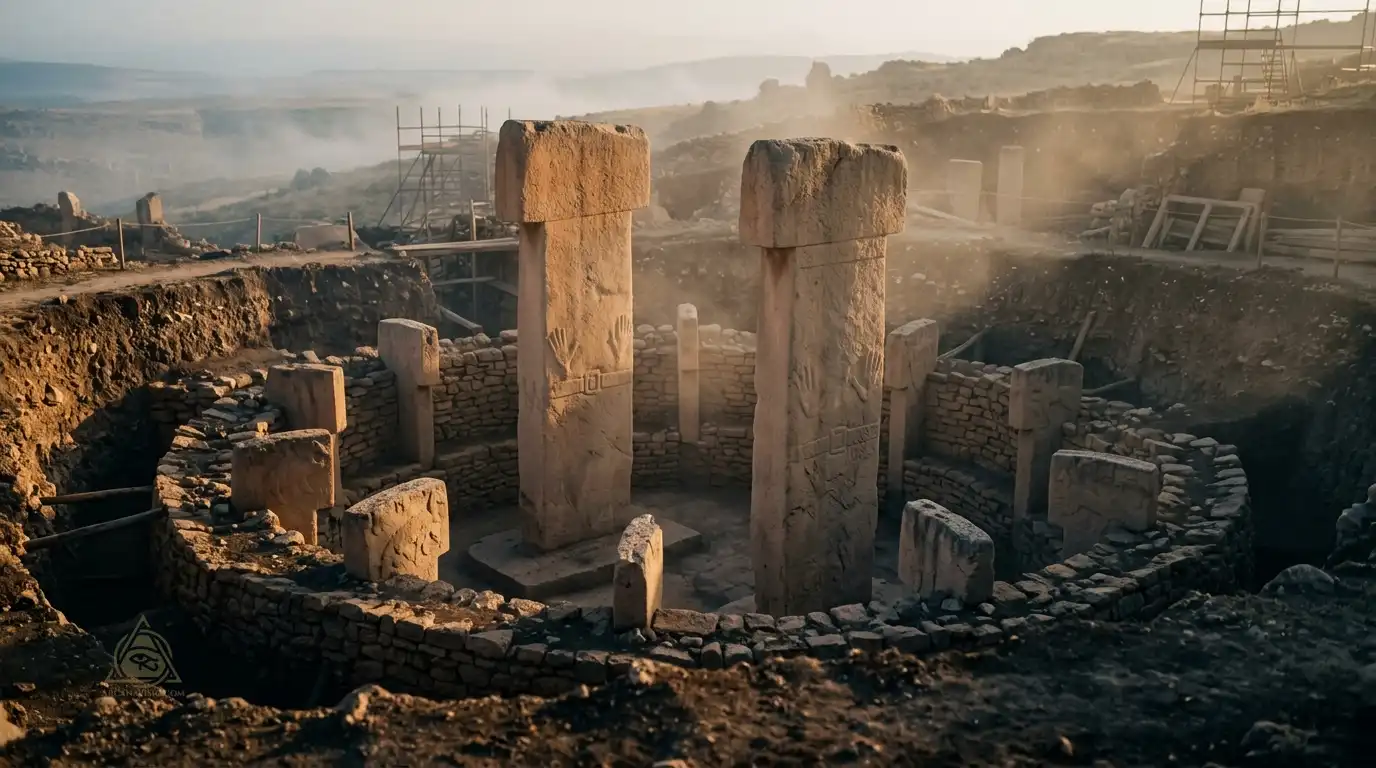
In 1994, German archaeologist Dr. Klaus Schmidt began excavations atop a barren limestone ridge in southeastern Anatolia, Turkey. What emerged from the dirt shattered the conventional timeline of human civilization forever.
Known as Göbekli Tepe (and its sister site, Karahan Tepe, within the broader Taş Tepeler network), the complex consists of dozens of circular and oval stone enclosures. Within each enclosure stand colossal, monolithic T-shaped limestone pillars, some exceeding eighteen feet in height and weighing up to twenty metric tons.
Secure radiocarbon dating of the organic sediment immediately revealed an impossibility according to mainstream history: the oldest strata date back to 9600 BCE (roughly 11,600 years ago).
This is the exact geological timestamp for the end of the Younger Dryas cataclysms and the precise date recorded by Plato for the destruction of the pre-flood world.
The 12,000-Year-Old Anomaly: Megalithic Engineering Predating Agriculture
According to orthodox anthropology, humanity 11,600 years ago consisted exclusively of scattered, primitive bands of nomadic hunter-gatherers, struggling for daily survival without pottery, domesticated animals, agriculture, or metal tools.
Yet Göbekli Tepe demanded:
- Advanced Civil Engineering: Quarrying, precisely shaping, and transporting twenty-ton monoliths without wheels or draft animals.
- Complex High-Relief Artistry: Sophisticated three-dimensional sculptures of lions, vultures, boars, foxes, and scorpions seamlessly carved directly out of living stone.
- Organized Workforce Architecture: Coordinating and feeding hundreds of specialized stonecutters, architects, and astronomers for decades in an area that lacked native agriculture.
Crucially, modern genetics reveals that the wild ancestors of domesticated einkorn wheat, barley, and chickpeas originated on the slopes immediately surrounding Göbekli Tepe. Agriculture did not invent civilization; civilization appeared fully formed at Göbekli Tepe, and agriculture was invented to sustain it.
Pillar 43: The Vulture Stone as a Precessional Chronometer and Cometary Record
The most celebrated monolith in Enclosure D is Pillar 43, popularly known as the Vulture Stone.
Carved into its limestone face is a complex astronomical tableau: a central vulture with outstretched wings holding a circular orb, flanked by a scorpion, an ibis, a headless human figure, and three strange “handbag” or chest motifs along the top border.
🔬 Scientific Foundation: In a rigorous 2017 study published in Mediterranean Archaeology and Archaeometry, researchers Dr. Martin Sweatman and Dimitrios Tsikritsis of the University of Edinburgh utilized astronomical software to map the animal symbols on Pillar 43 to celestial star constellations. The analysis demonstrated that the carvings operate as a specific astronomical date stamp: the animal figures represent the constellations of the zodiac (the vulture representing Sagittarius, the scorpion representing Scorpius), encoding the exact night sky configuration of the Younger Dryas cometary impact at approximately 10,950 BCE.
Pillar 43 is not decorative shamanism; it is a commemorative precessional clock recording the cosmic catastrophe that extinguished the preceding civilization.
The Ritual Burial: Why an Advanced Sanctuary Was Intentionally Interred
The greatest mystery of Göbekli Tepe is not how it was constructed, but how it ended.
Around 8000 BCE, after nearly two millennia of continuous astronomical and ritual use, the complex was not sacked by warring tribes, abandoned to the elements, or eroded by weather. The enclosures were deliberately and painstakingly backfilled by human hands.
Hundreds of thousands of metric tons of clean limestone rubble, sediment, and animal bones were brought up the hill to completely entomb the entire sanctuary, creating an artificial mountain (Tepe) that concealed the pillars from the sky for ten thousand years.
💡 Insight: You do not bury a city or a temple unless you intend to preserve it as a vault. Göbekli Tepe was an antediluvian time capsule—a sealed megalithic library designed to safeguard the mathematical, astronomical, and agricultural gnosis of a dying epoch until a future humanity possessed the intelligence to unearth it.
This deliberate preservation of sacred science links directly to the architectural lineage of Lost Civilizations & Ancient Gnosis. In the next section, we journey south along the ancient migration lines to examine the acoustic physics and megalithic engineering of Predynastic Egypt.
Acoustic Engineering and Sacred Architecture in Predynastic Egypt
Nowhere is the disconnect between academic dogma and material reality more striking than on the Giza Plateau in Egypt.
Standard Egyptological textbooks claim that the Great Pyramid of Giza was constructed around 2500 BCE over a span of twenty years by tens of thousands of conscripted peasants utilizing copper chisels, wooden rollers, and hemp ropes to serve as a lavish tomb for Pharaoh Khufu.
This narrative collapses upon contact with basic structural engineering.
The Great Pyramid contains over 2.3 million megalithic blocks, with individual limestone blocks weighing between two and fifteen metric tons, and colossal red rose granite ceiling beams in the King’s Chamber weighing up to seventy metric tons. To quarry, transport across five hundred miles from Aswan, lift hundreds of feet into the air, and place these blocks with mathematical precision in twenty years would require placing one finished block every two and a half minutes, twenty-four hours a day, without interruption.
More damning is the interior silence: across the millions of square feet of limestone and granite in the Great Pyramid, there is not a single original hieroglyphic inscription, no funerary artwork, no mummy, and no physical burial artifact.
The pyramids were never tombs. They were sophisticated geo-acoustic power plants and sanctuaries for the transmutation of consciousness.
Zep Tepi: The Golden Age of the Gods in Egyptian Memory
The dynastic Egyptians never claimed they invented the architecture of the pyramids. In texts carved across the temple walls of Edfu, Dendera, and Abydos, the priests recorded that their sanctuaries were built according to ancient architectural plans authored during Zep Tepi—“The First Time.”
The Turin Royal Canon (a papyrus dating to the 19th Dynasty) and the records of the third-century BCE Egyptian historian Manetho explicitly document that before the reign of Menes (the first mortal pharaoh, circa 3100 BCE), Egypt was governed for tens of thousands of years by divine beings (the Netjeru) followed by a semi-divine lineage known as the Shemsu Hor (“The Followers of Horus”).
The Edfu Building Texts specify that the sacred ground plans originated from a lost primeval island destroyed by a global cosmic deluge of fire and water. The survivors—the Seven Sages—established the foundation deposits across Egypt to rebuild the sacred order of the cosmos (Ma’at).
The Great Pyramid as an Acoustic Resonator: Piezoelectricity and Infrasound
Why did the builders of the Giza monuments transport thousands of tons of red granite over five hundred miles from southern quarries when abundant limestone was immediately available on site?
The answer lies in solid-state physics: quartz crystal content.
Aswan rose granite contains up to fifty-five percent silicon dioxide (quartz crystal). Under mechanical stress or acoustic vibration, quartz exhibits the piezoelectric effect—generating an electrical voltage under pressure. Furthermore, quartz acts as a transducer, converting electrical fields back into physical kinetic vibration.
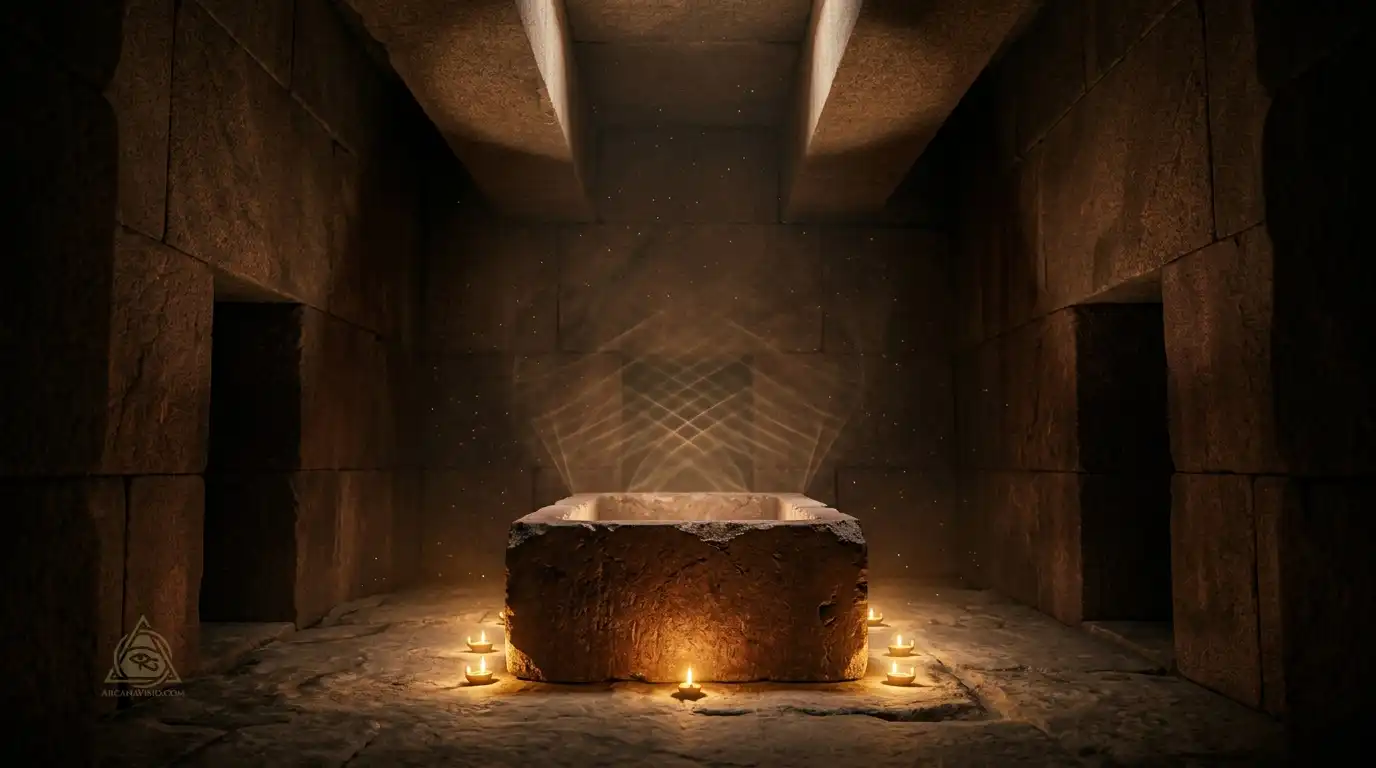
When engineer Christopher Dunn (The Giza Power Plant) and independent acoustic researchers analyzed the resonant frequencies of the King’s Chamber and its monolithic granite coffer, they discovered that the chamber acts as a tuned acoustic cavity:
- Striking the granite coffer causes the stone to ring like a deep metallic bell at an exact pitch of A (roughly 432 Hz harmonic tuning).
- The physical dimensions of the chamber and subterranean chambers resonate with infrasonic frequencies centered around 110 Hz.
🔬 Scientific Foundation: Neuro-acoustic studies conducted by researchers at UCLA, Stanford University, and Dr. Ian Cook demonstrated that acoustic resonance at 110 Hz causes a measurable neurological shift in human subjects. Brain activity monitored via EEG shifts from the left temporal lobe (governing analytical, linguistic, and chronological processing) to the right prefrontal cortex, deactivating the Default Mode Network and inducing states of profound emotional integration, heightened empathy, and spontaneous intuitive revelation.
Initiates who lay in the granite coffer during sacred rites were not waiting for physical burial. They were immersed in a focused piezoelectric, infrasonic resonance chamber designed to recalibrate the human bio-electric field and facilitate conscious dis-identification from the physical vessel.
Comparative Framework: Megalithic Architecture, Mainstream Dogma, and Gnostic Technology
| Megalithic Feature | Mainstream Academic Dogma | Archaeo-Acoustic & Engineering Reality | Operative Function for Consciousness |
|---|---|---|---|
| Giza Pyramid Interiors | Funerary tombs designed to preserve the physical corpse of a monarch. | Total absence of burial art, mummies, or inscriptions; precision-tuned granite acoustic cavities. | Acoustic resonance chambers inducing 110 Hz theta brainwave states and transpersonal awareness. |
| Aswan Rose Granite Beams (70 Tons) | Hauled on wooden sledges across desert sand by manual slave labor. | High-quartz crystalline substrate exhibiting piezoelectric and acoustic transducer properties. | Generating localized electromagnetic and vibrational fields via terrestrial telluric current. |
| Orientation to True North (3/60th degree accuracy) | Coincidental alignment achieved through primitive star-sighting sticks. | Mathematical precision surpassing modern construction tolerances; precessional celestial encoding. | Anchoring the structure to planetary axial geometry and macrocosmic star alignments. |
| The Great Sphinx Enclosure | Carved circa 2500 BCE by Pharaoh Khafre during the Old Kingdom. | Deep vertical precipitation fissures requiring continuous heavy rainfall prior to 7000–9000 BCE. | Astronomical equinoctial marker facing the constellation of Leo during the pre-flood epoch. |
💡 Insight: The ancients did not build with stone because they lacked computers. They built with stone because megalithic stone architecture endures for tens of thousands of years, preserving mathematical frequencies across global cataclysms that reduce modern digital infrastructure to dust.
This sophisticated mastery of frequency and matter mirrors our work on Somatic & Internal Alchemy. The human nervous system is an organic resonator; ancient megalithic temples were its external, macrocosmic amplifiers. In the next section, we trace the legendary lineage of the teachers who brought this gnosis across the floodwaters.
The Lineage of the Custodians: How Sacred Gnosis Survived the Deluge
If an advanced global civilization was shattered by the Younger Dryas cataclysms 11,600 years ago, how did its mathematical, architectural, and astronomical science survive to ignite the sudden emergence of dynastic Egypt, Sumer, and the Indus Valley?
The answer is preserved in the universal mythology of the ancient world: the arrival of the Civilizing Sages.
Across wildly disparate geographic cultures separated by vast oceans and thousands of miles, human folklore preserves an identical historical narrative: following a devastating global deluge, groups of enlightened travelers arrived by sea to teach traumatized hunter-gatherers the arts of agriculture, stone masonry, law, sacred geometry, and star navigation.
The Seven Sages: Global Memory of the Civilizing Travelers
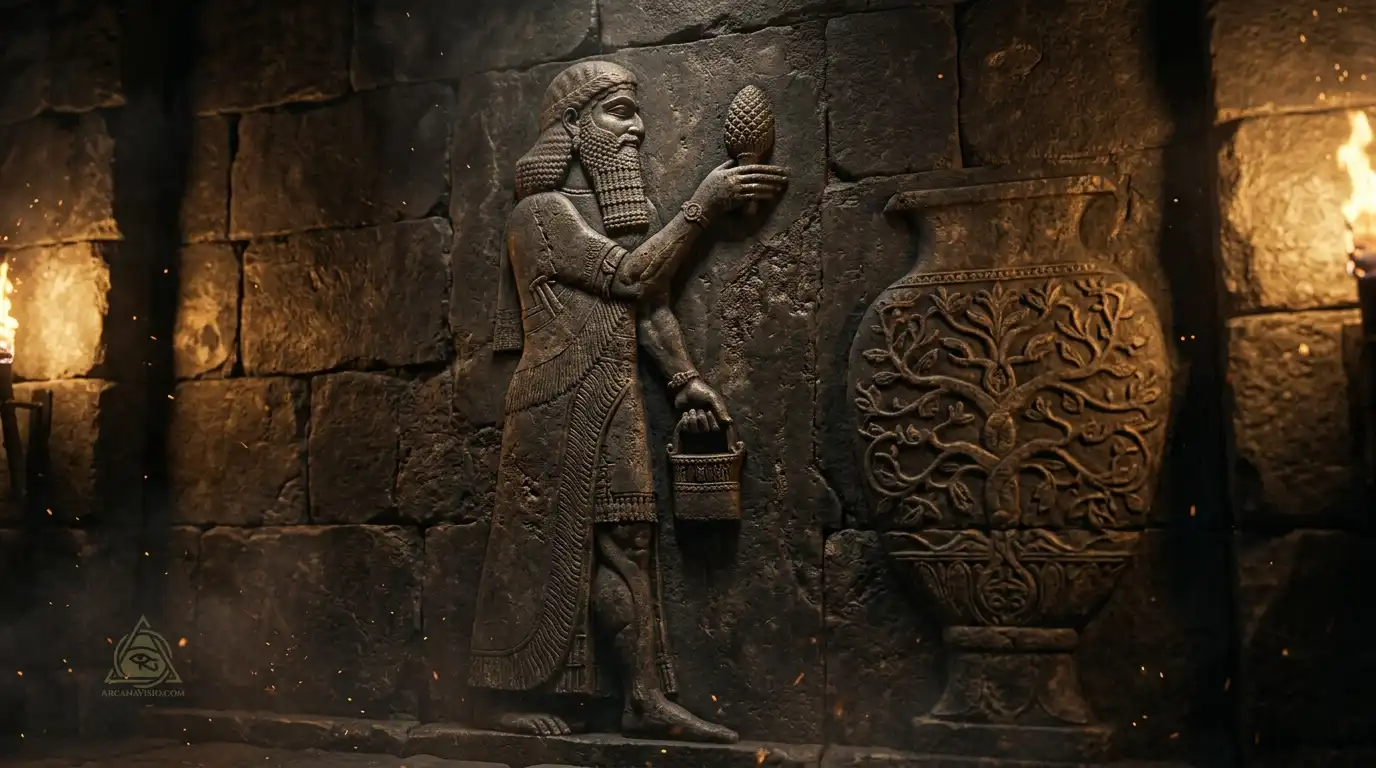
In Mesopotamia, the cuneiform tablets describe the Apkallu—the Seven Sages sent by the god of wisdom, Enki. Rising from the waters, they introduced writing, irrigation, and city-building to a shattered population before departing.
In ancient Egypt, the Edfu Building Texts record the identical tradition: following the sinking of the primordial island, the Shemsu Hor (The Followers of Horus) and the Seven Sages established foundation deposits throughout the Nile Valley to anchor the lost sciences of Zep Tepi.
In Mesoamerica and the high Andes, native traditions speak of Quetzalcoatl, Kukulkan, and Viracocha—tall, bearded civilizers who arrived from across the sea after the great flood, carrying advanced knowledge of mathematics, the 365-day calendar, and cyclopean masonry, strictly forbidding human sacrifice.
In ancient India, the Puranas detail the Saptarishi (the Seven Rishis) who were preserved aboard a great ark by the avatar Matsya during the Pralaya (the cosmic flood of Manu), ensuring that the sacred mathematics of the Vedas survived the destruction of the prior age.
🔬 Scientific Foundation: In their monumental comparative study Hamlet’s Mill: An Essay on Myth and the Frame of Time (1969), MIT professor of the history of science Giorgio de Santillana and Frankfurt University ethnologist Hertha von Dechend demonstrated that over thirty independent global mythologies—from Iceland and Polynesia to Mesopotamia and Pre-Columbian America—encode the exact mathematical rate of axial precession (one degree of shift every 72 years, 2,160 years per zodiacal age, 25,920 years for a complete Great Year). Primitive hunter-gatherers could not accidentally formulate identical precessional mathematics across continents; this gnosis was inherited from a shared pre-cataclysmic scientific tradition.
Consider the singular iconographic anomaly that links these continents: the mysterious “handbag” or bucket motif.
The winged Apkallu of ancient Sumer carry it. The central T-shaped monoliths at Göbekli Tepe (Pillar 43) depict three of them carved in stone 11,600 years ago. The colossal basalt stelae of the Olmecs in La Venta, Mexico, depict serpent deities holding the identical vessel. This was not a fashion accessory; it was the sacred emblem of the Custodians—symbolizing the seed-vault of civilization, carrying the concentrated biological and metaphysical DNA required to reboot humanity.
The Emerald Tablet and Antediluvian Technology
At the heart of this preserved inheritance stands the legendary Emerald Tablet (Tabula Smaragdina), attributed to Hermes Trismegistus (associated with the Egyptian deity of wisdom, Thoth).
Esoteric tradition records that the tablet was carved with diamond-hard tools onto a slab of synthetic, indestructible emerald stone to ensure its physical survival through cyclical planetary destructions.
Far from being a collection of superstitious spells, the Emerald Tablet is a hyper-condensed operational codex for physical and spiritual alchemy. It establishes that all manifest forms—matter, thought, and energetic vibration—are generated through the interaction of polar forces originating from a single, unified source: “That which is Below corresponds to that which is Above, and that which is Above corresponds to that which is Below, to accomplish the miracles of the One Thing.”
The Underground Stream: Preserving the Blueprint Across the Ages
When the ancient temple priesthoods foresaw the descent of historical consciousness into dogmatic religious literalism and material reductionism, they submerged the gnosis into an underground river of transmission.
The knowledge flowed from the mystery schools of Heliopolis and Memphis into the philosophical academies of Alexandria; from the Pythagorean brotherhoods into the Essene communities of the Dead Sea; and from the medieval Knights Templar into the alchemical guilds of the Renaissance.
When Cosimo de’ Medici financed the recovery of ancient Greek manuscripts in 1460, his first instruction to his translators was to ignore Plato and translate the freshly discovered Corpus Hermeticum first. The resulting rediscovery of ancient gnosis ignited the European Renaissance, giving birth to modern science, astronomy, and depth psychology.
💡 Insight: The sacred mysteries do not belong to the past; they belong to the eternal architecture of human potential. You are the descendant of survivors who preserved this fire across cosmic cataclysms so that you might remember who you are.
This ancient preservation directly connects to our foundational research on Hermetic Principles & Universal Laws. In the final section, we synthesize this lost gnosis to examine how understanding our forgotten origins restores sovereign clarity to modern life.
Frequently Asked Questions About Ancient Mysteries and Gnosis
What Caused the Collapse of Pre-Flood Advanced Civilizations?
The collapse was initiated by the Younger Dryas cataclysmic event between 12,800 and 11,600 years before present (BP). Geological evidence confirms that multiple fragments of a disintegrating comet struck the North American and European continental ice sheets. The resulting mega-airbursts triggered global wildfires, rapid climatic freezing, and colossal glacial meltwater outbursts (Meltwater Pulse 1B) that flooded the world’s coastlines. Advanced maritime civilizations—which naturally populated low-lying river valleys and ocean shores—were permanently drowned beneath rising sea levels.
How Old Is the Great Sphinx According to Geological Evidence?
While orthodox Egyptology dates the Sphinx to Pharaoh Khafre around 2500 BCE, forensic geoarchaeological research led by Dr. Robert M. Schoch proves that the core monument and its limestone enclosure walls exhibit profound vertical undulating fissures caused by continuous, heavy precipitation rainfall. Because hyper-arid desert conditions have prevailed over the Giza Plateau since roughly 3000 BCE, the heavy rainfall capable of producing this weathering last occurred during the African Humid Period. This dates the carving of the Sphinx to at least 7000–10,000 BCE, aligning with the astronomical Age of Leo.
Was Göbekli Tepe Built by Hunter-Gatherers or a Surviving Advanced Culture?
Nomadic hunter-gatherers struggling for basic daily subsistence lacked the socio-political organization, engineering logistics, and astronomical mathematics required to quarry, carve, and erect twenty-ton monoliths aligned with precessional star constellations. Göbekli Tepe represents a sudden, fully-formed transfer of technology. It was constructed by surviving adepts of a pre-cataclysmic civilization who established the site as an astronomical sanctuary, seed-vault, and civilizational reboot center for the surviving population.
What Was the Real Purpose of Acoustic Resonance in the Great Pyramid?
The Great Pyramid was not a tomb; it contains no original mummies, funerary artifacts, or hieroglyphs. It was engineered as a massive piezoelectric acoustic transducer. The King’s Chamber—constructed from rose granite containing 55% quartz crystal—acts as a tuned acoustic cavity resonating at 110 Hz and 432 Hz harmonics. Modern neuro-acoustics demonstrates that 110 Hz resonance deactivates the left temporal lobe and default mode network, shifting brainwave states into profound theta/alpha coherence for transpersonal consciousness initiation.
How Does Ancient Gnosis Relate to Modern Psychological Sovereignty?
Ancient civilizations understood that reality is governed by immutable metaphysical and mathematical principles—the identical universal laws explored in our work on The 7 Hermetic Principles and the Destiny Matrix Blueprint. When modern individuals live in historical amnesia, they assume human consciousness is a random biological accident. Rediscovering antediluvian gnosis proves that you are the inheritor of a sophisticated science of reality architecture designed to transcend victimhood and master conscious self-governance.
Conclusion: Reclaiming the Memory of Our Lost Greatness
Humanity stands today at a critical evolutionary crossroads, blinded by the hubris of technological materialism while severed from the roots of its ancient memory.
We look upon our electronic screens and assume we are the pinnacle of terrestrial intelligence. Yet the megalithic testimony of Göbekli Tepe, the precision-cut granite of Giza, and the universal memory of the Civilizing Sages tell a vastly different story: we are a species that has fallen from a profound height, slowly awakening from a ten-thousand-year coma.
The ancient mysteries were never designed to be admired as dead museum curiosities. They are living architectural blueprints. They remind you that consciousness precedes physical matter, that time is cyclical rather than linear, and that the human vessel is capable of conducting extraordinary spiritual current when properly calibrated.
By reclaiming this lost gnosis, you refuse to live as an amnesiac. You honor the sacrifices of the Custodians who carved the truth into living rock, and you step into the world as a sovereign architect of your own destiny.
The Arcana Visio Sanctum
True esoteric investigation demands moving beyond mainstream historical censorship into operative, systemic self-knowledge. For seekers dedicated to decoding ancient mysteries, universal laws, and archetypal mathematics, the Arcana Visio ecosystem offers three dedicated avenues of exploration:
- The Seeker Tier ($9/mo): Monthly 9-page executive PDF Grimoires formatted in signature obsidian and antique gold, delivering deep archaeoastronomical decodings, sacred geometry analyses, and ritual study frameworks inside the Arcana Visio Global Patreon.
- The Adept Tier ($29/mo): Advanced operative curricula featuring guided acoustic audio practices, planetary cycle transits, and quarterly transformational intensives designed for direct alchemical mastery.
- The Personal Blueprint (NAVIGATOR): To discover how your individual natal coordinates, karmic baggage, and financial portals align with the 22 universal Major Arcana frequencies, commission your individual 12-key manual through NAVIGATOR: 12 Keys to Yourself on Etsy or explore the architecture at arcanavisio.com.
