




📌 Core Essence: Somatic armor vagus nerve constriction represents the chronic muscular, fascial, and autonomic bracing patterns that trap human consciousness in low-grade fight, flight, or freeze states. By applying polyvagal neuroscience and targeted somatic de-armoring techniques, practitioners release trapped survival stress, activate the ventral vagal brake, and transform the physical body into an unshakeable vessel of sovereign presence.
You can possess monumental intellectual clarity, master complex strategic frameworks, and formulate ambitious plans for your life, yet find yourself mysteriously paralyzed the moment decisive action is required. Your conscious mind issues the command to advance, but your physical vessel hesitates: your breathing turns shallow, your throat tightens, your shoulders elevate toward your ears, and an invisible, leaden inertia cements your limbs. This debilitating impasse is not a failure of character, intellect, or spiritual discipline; it is an involuntary physiological lockdown initiated by your autonomic nervous system.
Nearly a century ago, Austrian psychoanalyst Wilhelm Reich observed that psychological repressions do not vanish into the ether of the mind; they solidify into the physical musculature as chronic tension rings, a phenomenon he designated as character armor or somatic armor. When early traumatic experiences, societal conditioning, or chronic survival pressures overwhelm the developing psyche, the body defends itself by freezing. It contracts the fascia, braces the diaphragm, and deadens emotional sensation to survive the acute threat. Decades later, while the original psychological danger has dissolved, the physical muscular cage remains locked in perpetual contraction.
Modern clinical neuroscience, spearheaded by Dr. Stephen Porges’s groundbreaking Polyvagal Theory, provides the biological mechanism behind Reich’s empirical observations. The human nervous system does not simply toggle between rational thought and raw emotion; it continuously monitors environmental safety through neuroception—a subconscious, subcortical radar scanning for threat below conscious awareness. When neuroception detects danger, it suppresses the myelinated ventral vagal complex—the physiological foundation for calm creativity, grounded social engagement, and sovereign leadership—and defaults either to frantic sympathetic mobilization or the cold, numbing paralysis of the unmyelinated dorsal vagal shutdown.
To command reality as a sovereign architect, one cannot treat the body as a disposable biological vehicle that passively obeys intellectual decrees. You must deconstruct the chronic holding patterns of somatic armor vagus nerve interference through the precise integration of polyvagal neuroscience, myofascial release, and breathwork alchemy. In this comprehensive foundational guide, we will analyze the biological evolution of somatic armoring, map the seven chronic muscular tension rings across the human frame, deconstruct the mechanics of the ventral vagal brake, and execute a four-step neuro-fascial protocol to dissolve the somatic armor and restore autonomic sovereignty.
The Physiology of Defense: Why Somatic Armor Vagus Nerve Blocks Paralyze Sovereign Will
To understand why traditional cognitive strategies fail to dissolve chronic procrastination and creative paralysis, one must trace the evolutionary wiring of the mammalian nervous system. The brain does not prioritize intellectual fulfillment, artistic legacy, or financial abundance; its primary biological imperative is survival. When an overwhelming event or chronic systemic stress floods the organism, the nervous system bypasses conscious prefrontal deliberation and initiates involuntary motor survival reflexes.
From Wilhelm Reich to Stephen Porges: The Evolution of Somatic Armoring
In the 1930s, Wilhelm Reich discovered that when an individual represses an instinctual emotional impulse—such as primal rage, intense grief, or vulnerable terror—the body executes that repression through sustained antagonistic muscular contraction. If a child is repeatedly punished for crying, they do not simply stop feeling sadness; they contract the throat, clench the jaw, and lock the intercostal muscles of the ribs to physically suppress the vocalization and diaphragmatic sobbing reflex. Over months and years, this defensive bracing becomes chronic. The muscles and their surrounding collagenous fascial wrappings shorten, calcify, and lose elasticity, forming a permanent armor that Reich identified as the physical embodiment of neurosis.
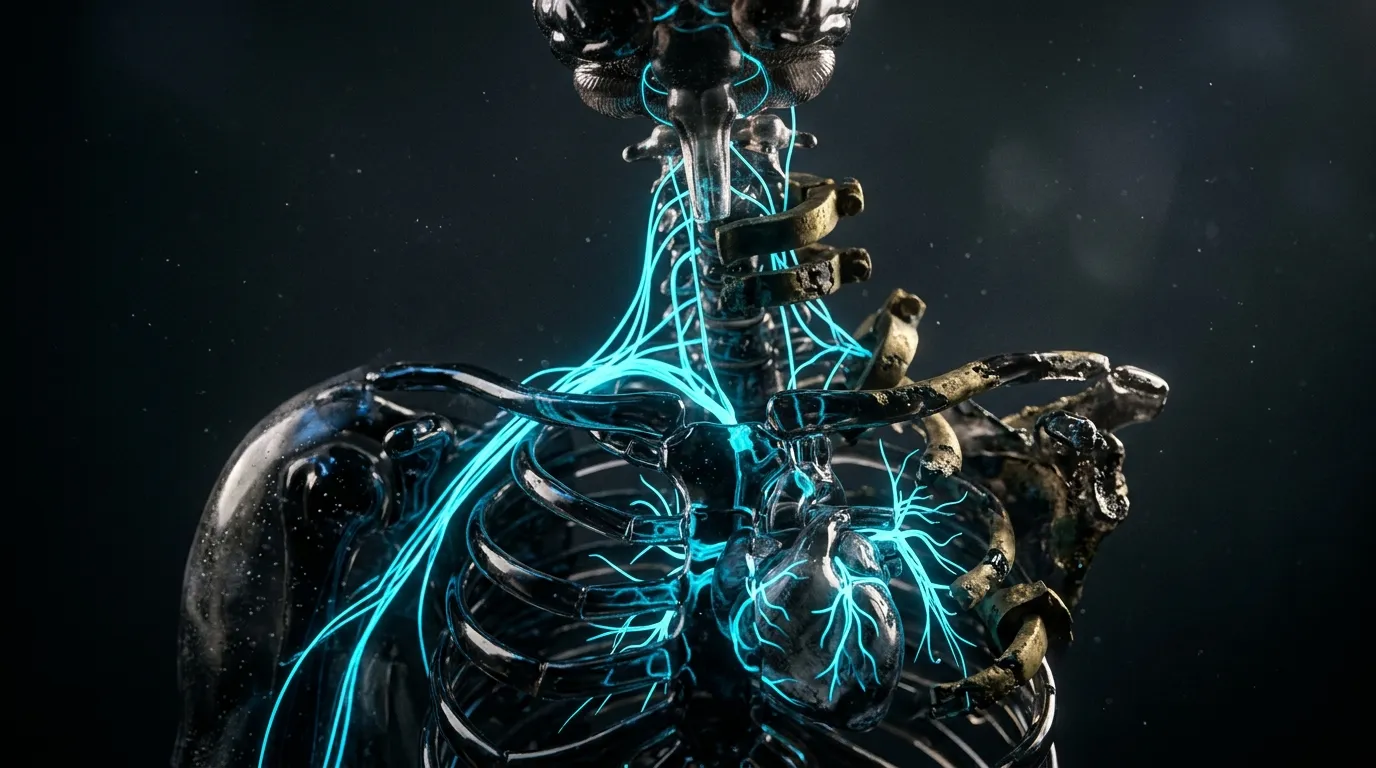
Half a century later, Dr. Stephen Porges’s Polyvagal Theory revealed the neurological architecture underpinning Reich’s discovery. The vagus nerve (the tenth cranial nerve) is not a single uniform conduit; it is a split, dual-pathway system originating from two distinct nuclei in the brainstem:
- The Phylogenetically Primitive Dorsal Vagal Complex: Originating in the dorsal motor nucleus, this unmyelinated pathway is shared with reptiles. When an organism faces overwhelming, inescapable threat, the dorsal vagal system fires, causing bradycardia (plummeting heart rate), metabolic drop, blood pressure collapse, and profound somatic numbness—the classic freeze or collapse response.
- The Phylogenetically Advanced Ventral Vagal Complex: Unique to mammals and originating in the nucleus ambiguus, this heavily myelinated, high-speed pathway innervates the heart, lungs, larynx, pharynx, and facial muscles. It acts as an active biological brake on the sympathetic fight-or-flight engine, enabling calm presence, clear social communication, and expansive cognitive synthesis.
When chronic survival stress remains unresolved, somatic armor vagus nerve entrapment takes place. The physical fascial tension around the neck, diaphragm, and pelvis compresses the vagus nerve trunk as it traverses the jugular foramen and the esophageal hiatus. This mechanical compression impairs vagal tone, locking the autonomic nervous system into a chronic low-grade dorsal freeze masquerading as chronic fatigue, brain fog, or executive dysfunction.
🔬 Scientific Foundation: Neuroception research proves that eighty percent of the vagus nerve’s fibers are afferent (sensory), transmitting signals from the visceral organs up to the brain, while only twenty percent are efferent (motor commands travelling downward). When chronic fascial armoring restricts the abdominal viscera and diaphragm, these afferent fibers continuously transmit visceral alarms of threat into the brainstem and amygdala, completely sabotaging prefrontal strategic planning regardless of how many logical arguments the conscious mind constructs.
The Seven Segments of Somatic Armoring: Mapping Chronic Tension Rings
Wilhelm Reich mapped the human body into seven horizontal armor segments functioning as functional energetic dams: the ocular, oral, cervical, thoracic, diaphragmatic, abdominal, and pelvic rings. For practitioners of reality architecture and depth psychology, as explored in our study of Jungian Archetypes, these segments operate as neuro-fascial bottlenecks that choke kinetic life-force (Prana / Vril) and fragment the sovereign will.

Fascial Memory and Neuro-Endocrine Constriction
Fascia is not inert wrapping tissue; it is a densely innervated liquid-crystalline matrix containing up to two hundred and fifty million sensory nerve endings—six times more than muscular tissue. Under sustained sympathetic arousal, fibroblasts within the fascia transform into contractile myofibroblasts, tightening the connective tissue matrix independently of conscious muscular commands.
Below is the anatomical deconstruction of the four primary action rings where somatic armoring paralyzes sovereign reality execution:
The Ocular & Suboccipital Ring (Perceptual Tunnel & Vigilance)
▪️ Anatomical Locus: The orbicularis oculi, forehead, scalp, and the dense suboccipital triangle muscles at the base of the skull.
▪️ Somatic Holding Pattern: Microscopic spasms triggered by narrow digital screen focal locks; chronic squinting, tension headaches, and locked vertebral arterial flow.
▪️ Psychological Expression: Obsessive over-intellectualization, paranoid hyper-vigilance, and inability to access open, peripheral receptive awareness.
The Throat & Jaw Ring (The Gate of Sovereign Voice)
▪️ Anatomical Locus: Masseter muscles, temporomandibular joint (TMJ), deep cervical flexors, pharynx, and root of the tongue.
▪️ Somatic Holding Pattern: Nocturnal teeth grinding (bruxism), a clenched jaw, swallowed emotional expression, and a chronically tight, elevated larynx.
▪️ Psychological Expression: Fear of articulating boundaries, suppressed vocal power, and the subconscious dread of taking up authoritative space in reality.
The Thoracic & Diaphragmatic Ring (The Vault of Breath & Will)
▪️ Anatomical Locus: Pectoralis major, intercostal rib muscles, thoracic spine, and the central respiratory diaphragm.
▪️ Somatic Holding Pattern: Chronic paradoxical breathing (chest breathing while the belly remains rigid), forward rounded shoulders, and an armoring plate over the sternum.
▪️ Psychological Expression: Emotional detachment, chronic vulnerability avoidance, shallow metabolic energy, and suppression of the heart’s electromagnetic field.
The Pelvic & Psoas Ring (The Root of Biological Courage)
▪️ Anatomical Locus: The iliopsoas muscle complex, gluteal musculature, pelvic floor, and deep hip rotators.
▪️ Somatic Holding Pattern: Chronic shortening of the psoas—the primary mammalian fight-or-flight muscle—locking the pelvis into an anterior or posterior tilt; pelvic floor hyper-tonicity.
▪️ Psychological Expression: Deep existential insecurity, chronic financial scarcity panic, and an inability to physically ground transcendent vision into tangible material reality.
💡 Insight: In Hermetic alchemy and the axiom of correspondence (As Above, So Below), your physical fascia is the material mirror of your energetic container. You cannot anchor a monumental reality vision if your solar plexus and diaphragm are clenched like a fist. Disarming the physical tissue is the mandatory biological prerequisite for psychological individuation.
Activating the Vagal Brake: Shifting from Survival Reactivity to Sovereign Presence
In automotive mechanics, a high-performance vehicle does not regulate its speed solely by stepping on the accelerator and turning off the engine; it relies on a finely calibrated braking system. The human autonomic nervous system operates under an identical physiological design. The sympathetic nervous system is your accelerator—flooding the cardiovascular system with adrenaline, noradrenaline, and cortisol to mobilize immediate survival energy. The ventral vagal complex is your biological brake.

Heart Rate Variability (HRV) as the Real-Time Metric of Somatic Power
The heart’s intrinsic pacemaker—the sinoatrial node—naturally beats at an elevated baseline rate of approximately one hundred to one hundred and ten beats per minute. When you are resting calmly in a state of autonomic safety, your heart rate does not sit at one hundred beats; it drops to sixty or seventy. This deceleration is not caused by the absence of sympathetic energy; it is actively maintained by the continuous inhibitory firing of the vagal brake.
With every inhalation, the vagal brake momentarily lifts, allowing heart rate to accelerate slightly to oxygenate arterial blood. With every slow exhalation, the vagal brake clamps down, releasing acetylcholine to rapidly decelerate cardiac rhythm. The beat-to-beat variation between these micro-phases is known as Heart Rate Variability (HRV).
When an individual’s nervous system is suffocated by somatic armor vagus nerve constriction, the vagal brake loses its regulatory agility. The system becomes rigid: either locked in permanent sympathetic acceleration (high anxiety, rapid heartbeat, defensive irritability) or collapsing into unmyelinated dorsal numbness (apathy, chronic fatigue, depressive paralysis). High heart rate variability is the physiological signature of autonomic resilience—the capacity of a reality architect to confront high-stakes chaos, absorb immense systemic pressure, and instantly restore internal equilibrium without biological burnout.
The Ventral Vagal Anchor: Projecting Presence Without Biological Exhaustion
True leadership and creative authority do not project from cognitive bravado or aggressive dominance; they emanate from a regulated ventral vagal state. When your ventral vagus nerve is fully engaged, your facial expressions convey authentic warmth, your vocal intonation exhibits natural prosodic melody, and your physical presence transmits an undeniable aura of somatic safety.
Through the biological phenomenon of interpersonal co-regulation, human nervous systems constantly communicate below conscious awareness. When you enter a room anchored in genuine somatic sovereignty, dysregulated individuals around you involuntarily entrain to your calm autonomic stability. You command reality not by fighting external friction, but by establishing an immovable physiological foundation that reorganizes the surrounding human field.
🔬 Scientific Foundation: Clinical research conducted at the Institute of HeartMath and Harvard Medical School confirms that high cardiovagal tone (measured through high-frequency HRV) directly modulates the prefrontal cortex’s executive networks. When the vagal brake is dynamic, afferent neural signals stimulate the anterior cingulate cortex, enhancing cognitive flexibility, emotional impulse control, and intuitive decision-making under acute strategic uncertainty.
The Somatic De-Armoring Protocol: A Four-Step Neuro-Fascial Reset
To permanently dismantle somatic armoring, one must bypass intellectual discourse and work directly with fascial mechanics, ocular reflexes, and vocal nerve pathways.
The following four-step protocol integrates osteopathic suboccipital release, vagal pharyngeal stimulation, diaphragmatic fascial uncoupling, and neurogenic psoas tremoring. Execute this fifteen-minute somatic practice in a quiet, undisturbed space, dressed in comfortable clothing, with a flat floor or yoga mat:

Step 1: Suboccipital Release & Saccadic Stillness
Lie flat on your back on a firm floor or mat, with your knees bent and feet flat on the ground. Place two rubber therapy balls or a rolled hand towel horizontally beneath the base of your skull, directly over the suboccipital triangle muscles.
Allow the full weight of your head to drop heavily into the pressure points for ninety seconds, taking slow, unforced breaths into the belly. Without moving your head, slowly shift your eyeballs as far to the right as comfortably possible while keeping your eyelids soft. Hold your gaze at the extreme right for thirty to sixty seconds until you experience an involuntary autonomic release reflex—such as a deep sigh, a spontaneous swallow, or a yawn. This basic exercise (pioneered by somatic therapist Stanley Rosenberg) mechanically resets the alignment of the C1 and C2 vertebrae and instantly stimulates the ventral vagus nerve trunk. Return your eyes to center and repeat on the left side.
Step 2: Pharyngeal Toning and Guttural De-Constriction
Sit up in a comfortable cross-legged posture with a tall, relaxed spine. The superior branches of the vagus nerve innervate the soft palate, pharynx, and vocal cords; activating these muscles mechanically tones the vagal brake.
Take a deep diaphragmatic inhale through the nose. On the exhale, produce a loud, low-pitched gargling or guttural humming sound: “Vvvvvvv” or a deep, resonant “Oooohhhmmm”, vibrating the vibration strongly against the roof of the mouth and the back of the throat. Emphasize the tactile sensation of vocal friction in the throat tissues. Complete eight continuous breath cycles, allowing any suppressed emotional sighs or vocal tremors to discharge freely without rational censorship.
Step 3: Diaphragmatic Myofascial Uncoupling
Remain seated and place the fingertips of both hands just beneath your ribcage at the solar plexus. Inhale deeply, allowing your belly to swell outward like a balloon.
On the exhale, lean your torso slightly forward, gently pressing your curled fingertips upward and inward beneath the lower edge of the ribs, physically engaging the connective tissue of the respiratory diaphragm. Hold this gentle manual pressure as you exhale completely through pursed lips. Then, execute a physiological sigh: take a deep, sharp inhale through the nose to seventy percent, immediately take a second sharp sniff of air to top off lung capacity, and release a long, unforced vocalized sigh through the mouth: “Haaaaahhh”. Repeat three times to collapse residual alveolar tension and release the thoracic armor segment.
Step 4: Psoas Tremoring & Grounding Discharge
Lie flat on your back once more. Place the soles of your feet together with your knees open wide in a butterfly posture (reclining bound angle pose). Slowly elevate your pelvis three inches off the floor and hold for sixty seconds until your inner thighs and groin begin to fatigue.
Slowly lower your hips back to the floor. Bring your knees inward by one inch, leaving a small gap between them, and press your feet gently into the mat. As the fatigued iliopsoas muscles stabilize, you will notice an involuntary, rhythmic trembling or shaking begin in your pelvis and thighs. Do not clamp down or control the tremor; this neurogenic tremoring is the mammalian nervous system’s natural biological mechanism for discharging frozen survival energy from the psoas muscle. Allow the tremors to ripple through your pelvis and lower back for three to five minutes. Straighten your legs completely, rest in absolute silence for two minutes, and feel the dense somatic armor give way to spacious, grounded biological sovereignty.
Frequently Asked Questions About Somatic Armoring and the Vagus Nerve
How can you tell if your nervous system is trapped in dorsal vagal freeze?
A dorsal vagal shutdown rarely announces itself through dramatic panic; it masquerades as a chronic, leaden inability to engage with life. Key physiological and psychological indicators include persistent brain fog, emotional numbness or anhedonia (the inability to experience joy), cold extremities due to peripheral vasoconstriction, chronically low resting heart rate combined with postural exhaustion, and a compulsive urge to dissociate into mindless screen scrolling. If you find yourself staring at an urgent work task with intellectual comprehension of its importance yet completely unable to mobilize your physical hands to type, you are not suffering from lazy discipline; you are caught in a dorsal vagal freeze.
Can somatic de-armoring trigger spontaneous emotional crying or shaking?
Yes, and such reactions are the definitive biological hallmarks of successful therapeutic release. When chronic fascial armoring dissolves around the diaphragm, throat, or pelvis, the nervous system discharges survival energy that was mechanically frozen during past overwhelming events. It is entirely common to experience spontaneous tremors (neurogenic shaking), sudden unprovoked weeping without cognitive sadness, deep involuntary yawning, or temporary temperature swings (such as intense flushes of heat or shaking chills). These physical manifestations indicate that interrupted motor survival reflexes are finally completing their physiological cycle.
Why does foam rolling or deep tissue massage alone fail to release somatic armor?
Standard deep tissue massage and foam rolling treat the body as an inanimate mechanical structure of meat and cables. While aggressive manual pressure can temporarily crush tight muscle fibers, if the autonomic nervous system still perceives the internal or external environment as fundamentally unsafe, the subcortical brain will order the fibroblasts to tighten the fascia right back up within forty-eight hours. Permanent de-armoring requires neurological buy-in: you must combine fascial release with slow diaphragmatic exhalation, suboccipital resetting, and ventral vagal signaling to prove to the nervous system that it is biologically safe to lower its shields.
How does the vagus nerve influence executive function and decision-making?
The vagus nerve is the biological foundation of strategic intuition. Eighty percent of its fibers transmit visceral sensory data from the enteric nervous system (the “gut brain”) directly into the nucleus tractus solitarius in the brainstem, which routes signals to the insular cortex and amygdala. When vagal tone is elevated, these visceral signals arrive as clear somatic markers—what we colloquially recognize as “gut feelings” or sharp instinctual discernment. When the vagal trunk is mechanically pinched by cervical or diaphragmatic armoring, intuitive signals degrade into erratic static, forcing the prefrontal cortex to over-analyze every decision until analysis paralysis sets in.
What is the difference between sympathetic fight-or-flight and the freeze response?
The sympathetic fight-or-flight response is an active, high-metabolic mobilization state: heart rate accelerates, pupils dilate, blood pressure spikes, and blood rushes to the major skeletal muscles to prepare the organism to attack or flee. The freeze response (dorsal vagal collapse) is a low-metabolic conservation state: when the subcortical brain determines that neither fighting nor fleeing is biologically possible, it slams the system into playing dead. In human life, chronic freeze manifests not as literal fainting, but as chronic functional procrastination, social withdrawal, emotional flatness, and metabolic fatigue.
How long does it take to permanently dismantle chronic somatic character armor?
Dismantling somatic armoring is not an overnight breakthrough; it is a physiological remodeling process governed by collagen turnover and neural re-patterning. Significant relief from acute muscular tension, improved heart rate variability, and deeper diaphragmatic breathing typically emerge within three to four weeks of consistent daily somatic practice. Completely remodeling calcified fascial architecture and re-training the autonomic nervous system to default to ventral vagal sovereignty usually requires three to six months of regular somatic de-armoring, breathwork integration, and conscious postural recalibration.
Conclusion: Reclaiming the Body as a Sovereign Alchemical Vessel

To treat your physical body as an inconvenient biological shell meant only to carry an intellect from meeting to meeting is the ultimate modern pathology. The flesh is not dumb matter; it is the physical baseline of your reality field. Every unresolved emotional compromise, every swallowed boundary, and every suppressed creative impulse is stamped directly into the cellular lattice of your fascia.
When you refuse to dismantle your defensive armor, the armor inevitably becomes your tomb. It locks you into a chronic reactive posture, defending against phantom threats long after the battle has ceased. By mastering the neurobiology of somatic armor vagus nerve de-constriction, you execute the ultimate act of internal alchemy: you strip away the petrified armor of the past and step forward with an open, resilient, and unshakeable nervous system—standing as the true sovereign architect of your embodied reality.
Enter the Arcana Visio Sanctum

Deepen your exploration of archetypal systems, esoteric geometry, and sovereign reality design through our dedicated study spaces:
- Arcana Visio Sanctum on Patreon: Join our private study community for practitioners exploring depth psychology, internal alchemy, and reality architecture. Access monthly visual PDF Grimoires, advanced operative protocols, guided somatic audio practices, and ongoing research archives at patreon.com/c/ArcanaVisio.
- NAVIGATOR: 12 Keys to Yourself: Ready to decode the exact financial triad, karmic tail, and core life-purpose codes encoded in your unique natal geometry? Order your personalized, high-ticket Destiny Matrix diagnostic manual on Etsy or explore the complete methodology at arcanavisio.com/navigator/.
- The Arcana Visio Dispatch (Newsletter): Receive our weekly long-form essays, practical somatic protocols, and private releases on depth psychology, cosmic cycles, and consciousness architecture directly to your inbox via arcanavisio.substack.com.
