



📌 Core Essence: Acoustic pyramid resonance represents the precise engineering of megalithic chambers to amplify low-frequency sound, seismic vibrations, and electromagnetic harmonics. Utilizing quartz-dense rose granite, specific volume ratios, and Helmholtz resonance cavities, ancient builders transformed stone structures into functional energetic transducers that shifted human brainwaves into profound meditative states.
For more than a century, orthodox archaeology insisted on viewing the monumental stone structures of the ancient world through a single, narrow lens: the tomb. Generations of students were taught that the Great Pyramid of Giza, the subterranean megalithic chambers of Malta, and the corbeled stone passages of Newgrange were primitive sepulchers erected at catastrophic human cost to house the mortal remains of egotistical monarchs. Yet inside the Great Pyramid, not a single mummy, royal inscription, or funerary artifact was ever discovered in situ. The massive red granite coffer in the King’s Chamber bears no likeness to ornate Egyptian sarcophagi; it is an unpolished, acoustically tuned stone basin cut with mathematical precision from a single block of high-quartz stone.
When acoustic engineers and geophysicists enter these spaces with calibrated frequency generators and magnetometers, the tomb hypothesis permanently collapses. Megalithic monuments do not behave like dead stone mausoleums; they behave like macroscopic musical instruments, acoustic wave guides, and piezoelectric transducers. As explored in our architectural investigation of Sacred Mysteries and Ancient Gnosis, ancient builders selected their geological materials with sophisticated understanding. They transported seventy-ton granite blocks more than eight hundred kilometers from Aswan to Giza, ignoring millions of tons of soft, easily accessible limestone beneath their feet, specifically because quartz-bearing granite possesses unique electromechanical properties under physical stress.
The human brain is not an isolated spectator within these stone sanctuaries; it is a resonant acoustic receiver. Modern neuro-imaging reveals that when an individual enters a chamber tuned to the fundamental frequency of 110 to 111 Hertz—the acoustic hallmark of megaliths across Europe, North Africa, and South America—a dramatic shift occurs in neural activity. The language and analytical control centers in the left temporal lobe temporarily power down, while the right hemisphere activates, inducing deep theta-wave meditative states, enhanced creative visualization, and profound nervous system equilibrium.
To understand ancient reality architecture, we must deconstruct the physics of acoustic pyramid resonance through the intersection of materials science, geophysics, and neurobiology. In this comprehensive guide, we will analyze the piezoelectric properties of Aswan rose granite, map the 110 Hertz acoustic signature across four continents, decode the planetary telluric grids beneath megalithic sites, and execute a four-step vocal toning protocol to harness these foundational frequencies within your own somatic biology.
The Physics of Ancient Sound: Why Acoustic Pyramid Resonance Alters Consciousness
To comprehend how megalithic structures interact with the human body, one must first dismantle the modern dichotomy between architectural acoustics and solid-state physics. The materials chosen by ancient builders were not inert masses; they were active electromechanical substrates. In the subterranean chambers of Giza, the builders bypassed local limestone and constructed the entire core of the King’s Chamber out of red and rose granite quarried hundreds of miles away in Aswan.
Piezoelectric Quartz and Electrostriction in Megalithic Granite
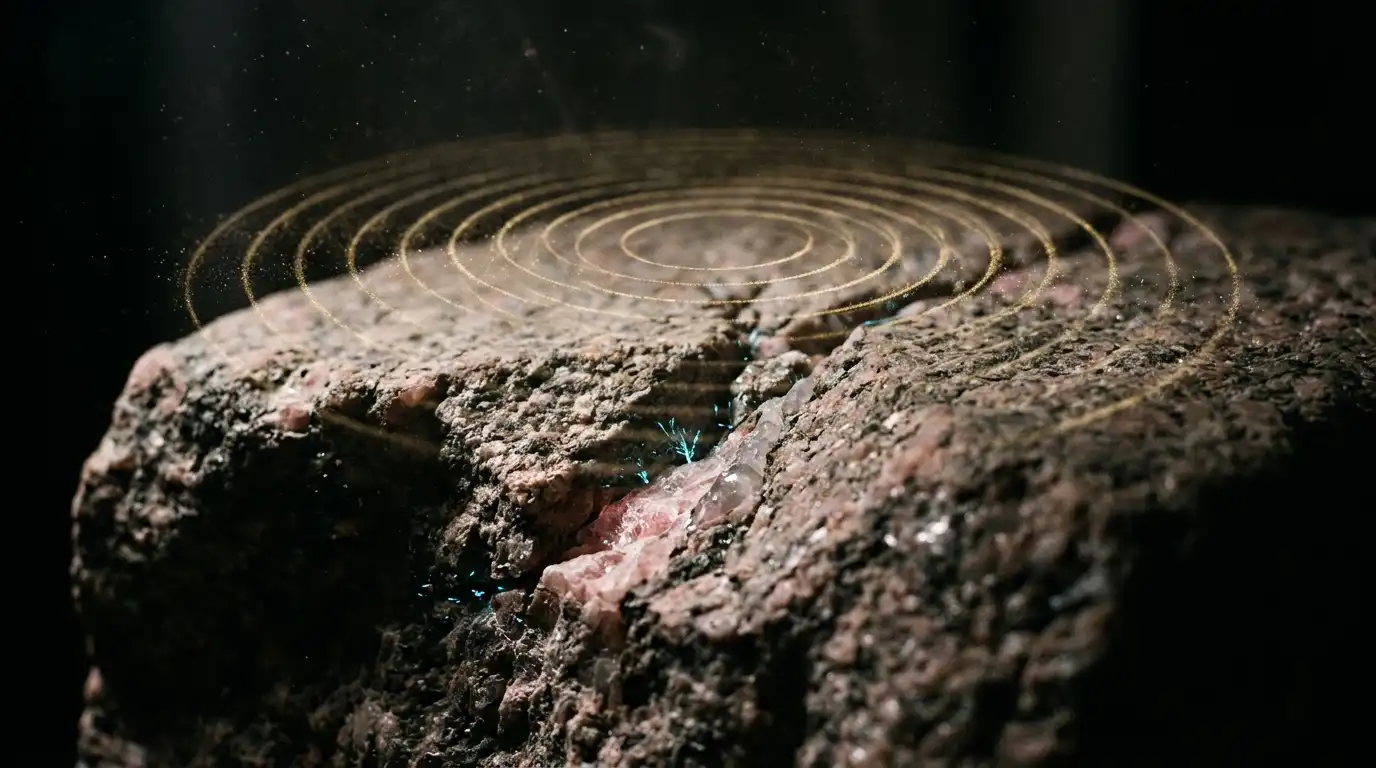
Aswan rose granite is exceptionally dense with silicon dioxide ($SiO_2$) quartz crystals, comprising up to fifty-five percent of its mineral volume. In 1880, physicists Jacques and Pierre Curie discovered the piezoelectric effect: when asymmetrical crystalline lattices such as quartz are subjected to mechanical compression or physical vibration, their internal ionic charges separate, generating a measurable electrical voltage across the crystal faces. Conversely, through electrostriction, applying an oscillating electrical current causes the crystal lattice to expand and contract, converting electricity back into physical acoustic sound waves.
The King’s Chamber does not sit resting quietly upon bedrock; it is an isolated granite room suspended within millions of tons of limestone blocks, topped by five tiers of massive granite beams weighing up to seventy tons each. Under the constant gravitational pressure of the monument and the daily tidal pull of the Moon, these quartz crystals are locked in perpetual mechanical tension. When low-frequency acoustic sound—whether from rhythmic human chanting, seismic vibrations along the Nile fault line, or subterranean water flow—echoes through the chamber, the granite acts as an electromechanical transducer. Through acoustic pyramid resonance, mechanical sound vibrations are continuously converted into localized electrostatic charges and pulsed atmospheric ionization.
The 110 Hz Harmonic Key: Neuro-Acoustic Deactivation of the Left Temporal Lobe
What purpose did this electromechanical transducer serve? The answer lies in the human auditory and nervous systems, as explored in our foundational research on Somatics and Internal Alchemy. Sound is not merely a cognitive phenomenon heard by the ears; it is a mechanical force that travels via bone conduction directly into the cerebrospinal fluid, the sphenoid bone, and the skull’s cranial sutures.
When acoustic engineers map ancient stone sanctuaries across the globe, an extraordinary mathematical pattern emerges: regardless of cultural or geographic distance, these chambers are tuned to resonate between 110 and 112 Hertz. This frequency corresponds to an $A_2$ pitch in Western acoustics—a deep, resonant bass note natural to the adult male baritone voice.
🔬 Scientific Foundation: In 2008, Dr. Ian A. Cook and a team of neuroscientists at the University of California, Los Angeles (UCLA) conducted EEG and functional neuro-imaging on human subjects exposed to different acoustic frequencies inside stone chambers. At 90 Hz, 100 Hz, or 130 Hz, brainwave activity showed no unusual patterns. However, precisely at 110 Hz and 111 Hz, a dramatic neurological shift took place: regional cerebral blood flow and electrical activity in the left temporal lobe (the center of analytical speech, critical judgment, and anxiety) dropped significantly, while the right prefrontal cortex deactivated its default mode network. The brain shifted out of restless beta waves into synchronized theta (4–8 Hz) and deep alpha states, inducing states of emotional transcendence, heightened visual spatial intuition, and somatic stillness without sleep.
Inside the Giza Transducer: Decoding the Acoustics of the King’s Chamber
The architectural dimensions of the King’s Chamber are not decorative; they are configured as an acoustic Helmholtz resonator—a cavity where a volume of air vibrates intensely when an external sound frequency matches the chamber’s resonant geometry. Built to the proportions of the Golden Ratio ($\Phi$), as examined in our study of Sacred Geometry Patterns, the room’s length (twenty royal cubits), width (ten cubits), and height (eleven point one eight cubits) create a double-cube volume that functions as an acoustic wave guide.
The Acoustic Helmholtz Resonator: Subterranean Cavities, Sarcophagus, and Granite Beams
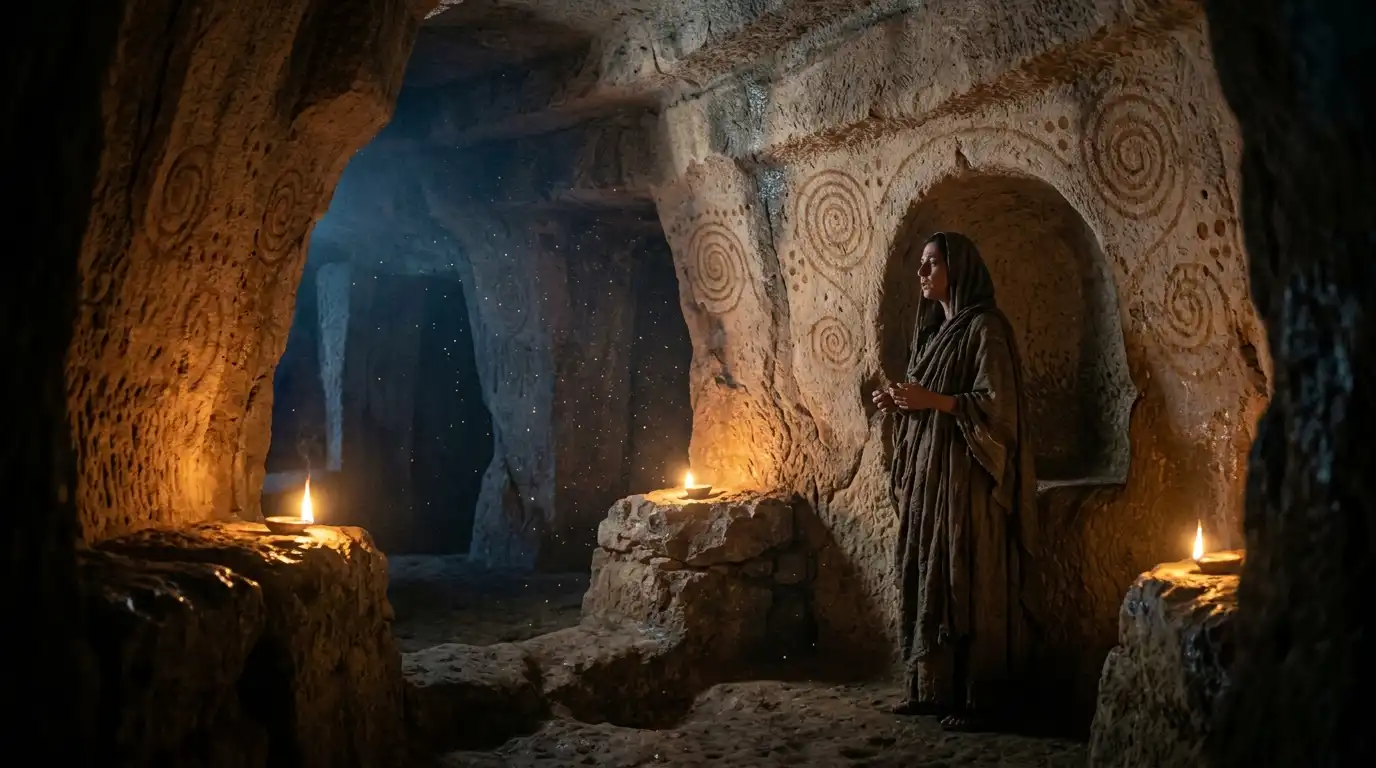
In 1996, acoustic technician and engineer John Stuart Reid carried out rigorous acoustic mapping inside the King’s Chamber using a calibrated speaker and pure sine wave sweep generators. Reid discovered that striking the monolithic granite coffer produced a deep, sustaining tone at 117 Hz, which instantly entrained the entire room. Furthermore, when he produced tones inside the chamber, the granite beams in the ceiling began to resonate in phase, acting like giant acoustic tuning forks that sustained standing waves for seconds after the initial tone ceased.
This phenomenon of acoustic pyramid resonance was not unique to Egypt. Across prehistoric civilizations, master architects used differing stone and soil morphologies to achieve an identical acoustic end:
The King’s Chamber (Giza Plateau, Egypt)
▪️ Acoustic Signature & Resonance: 110 Hz fundamental resonance, harmonic spikes at 220 Hz and 432 Hz, coffer resonance at 117 Hz.
▪️ Architectural Mechanics: High-quartz rose granite, isolated five-tier stress-relieving granite ceiling, two acoustic air shafts tuned to high harmonics.
▪️ Physiological & Archetypal Impact: Deep cranial bone conduction, suppression of the left temporal lobe, activation of the endocrine system through piezo-induced atmospheric ionization.
The Hypogeum of Hal Saflieni (Valletta, Malta)
▪️ Acoustic Signature & Resonance: Precise 110 Hz standing wave resonance inside the subterranean Oracle Chamber.
▪️ Architectural Mechanics: Carved directly into living globigerina limestone; curvilinear acoustic niches carved into the walls that act as directional acoustic amplifiers.
▪️ Physiological & Archetypal Impact: A male voice chanting inside the Oracle Chamber reverberates through the three subterranean tiers, causing acoustic vibrations to hum intensely through the teeth, sphenoid bone, and ribs of anyone standing inside the sanctuary.
Newgrange Megalithic Passage Tomb (County Meath, Ireland)
▪️ Acoustic Signature & Resonance: Strong standing wave resonance at 110 Hz to 112 Hz when chanting inside the central cruciform chamber.
▪️ Architectural Mechanics: Sixty-two-foot narrow stone passageway leading into a corbeled stone vault covered by hundreds of thousands of tons of river pebble cairn.
▪️ Physiological & Archetypal Impact: During winter solstice, acoustic sound waves amplify along the passage, interacting with incoming solar light rays to create a total sensory and auditory reset.
Chavín de Huántar Ceremonial Center (Ancash, Peru)
▪️ Acoustic Signature & Resonance: Acoustic drone between 100 Hz and 115 Hz generated by subterranean hydraulic channels beneath the stone plaza.
▪️ Architectural Mechanics: Complex underground labyrinth of stone ducts engineered to channel roaring mountain river water beneath ceremonial chambers; carved marine conch trumpets (*Pututus*).
▪️ Physiological & Archetypal Impact: Ancient initiates placed inside the dark stone labyrinth were subjected to infrasonic and acoustic roar resembling an earthquake or roaring jaguar, completely dissolving the waking ego.
💡 Insight: The geographic ubiquity of the 110 Hz frequency proves that these megalithic sanctuaries were not decorative tombs, but functional psycho-acoustic initiation chambers. By designing rooms that naturally amplify this specific frequency, ancient architects built external neuro-acoustic technologies that reliably induced non-ordinary states of consciousness without pharmaceutical substances.
Earth Currents and Telluric Grids: How Megaliths Tap Into Planetary Energy Lines
Acoustic resonance inside a stone chamber cannot be understood in isolation from the ground upon which it rests. Just as a cathedral organ requires a steady supply of pressurized air to vibrate its massive lead pipes, ancient megalithic monuments required a constant source of low-frequency telluric energy to maintain their acoustic and piezoelectric charge. Ancient engineers did not choose their construction sites arbitrarily; they built upon localized geological anomalies where subterranean tectonic stress, underground aquifer intersections, and natural geomagnetic currents converge.

Telluric Currents, Ground Conductivity, and Radon Ionization at Sacred Sites
Beneath the Earth’s surface flows a complex network of low-frequency electrical currents known in geophysics as telluric currents. Driven by the solar wind, the geomagnetic dynamo of the liquid iron outer core, and oceanic tidal movements, these currents travel through the crust along paths of least electrical resistance. Fault lines, subterranean mineral veins, and underground waterways act as natural electrical conductors, concentrating telluric energy along linear geographical corridors often preserved in folklore as ley lines or dragon currents.
At sites such as Carnac in Brittany, Avebury in Wiltshire, and the Giza Plateau, the bedrock exhibits exceptional geological conductivity. When tectonic plates shift—even on micro-seismic scales imperceptible to human senses—the friction generates piezoelectric charges within subterranean quartz deposits. This energy rises to the surface, where massive standing megaliths act as stone capacitors, storing and slowly discharging electrical energy into the surrounding atmosphere. Furthermore, the porous limestone and granite structures channel naturally occurring radon gas and negative air ions from deep fractures, creating localized electromagnetic micro-climates that stimulate cellular regeneration and autonomic nervous system regulation.
Standing Waves and Geometric Alignment: Coupling Megalithic Siting to the Schumann Resonance
The Earth and its conductive ionosphere form a closed spherical cavity resonator that vibrates continuously at an extremely low frequency (ELF) fundamental of 7.83 Hertz—known as the Schumann Resonance—with higher harmonic overtones at 14.3 Hz, 20.8 Hz, and 27.3 Hz. This planetary frequency matches the human brain’s alpha-theta threshold, the bridge between waking consciousness and subconscious reprogramming.
Megalithic sites were engineered to act as acoustic transducers between these planetary infrasonic frequencies and the audible human spectrum. When seismic shear waves and telluric hums pass upward through the pyramidal geometry, the structure functions as an inverted acoustic funnel. Through acoustic pyramid resonance, sub-audible planetary vibrations are stepped up through physical harmonic multiplication, emerging inside the chambers at audible frequencies—most notably the 110 Hz overtone (which is the fourteenth harmonic of 7.83 Hz).
🔬 Scientific Foundation: During the 1980s and 1990s, the Dragon Project—an interdisciplinary scientific study led by physicist Paul Devereux and Oxford bio-physicists—conducted exhaustive magnetometer, ultrasonic, and radiation surveys across British megalithic stone circles. At dawn, precisely as the rising Sun struck the stones, the instruments recorded sudden spikes in ultrasonic emissions and localized magnetic field fluctuations that were entirely absent in the surrounding open fields. The megaliths were literally “clicking” on an ultrasonic register as solar heating and geomagnetic ionization caused the quartz crystals to pulse.
The Ancient Sound Resonance Protocol: A Four-Step Somatic Vagal Reset
You do not need to stand inside the King’s Chamber or fly to the subterranean caverns of Malta to harness the transformative power of ancient acoustic engineering. Your own human skull is an organic stone chamber: your teeth are crystalline enamel, your sphenoid bone at the center of the cranial base sits directly beneath the pituitary gland, and your vocal cords can be calibrated as an internal acoustic frequency generator.
By practicing focused vocal toning at the 110 Hz register, you create internal standing waves that travel through your skeleton via bone conduction. This mechanical vibration stimulates the auricular and pharyngeal branches of the vagus nerve, resets the autonomic nervous system, and increases nitric oxide ($NO$) production in the nasal passages by up to fifteen-fold, dilating blood vessels and supercharging cerebral oxygenation.
Execute this twelve-minute protocol seated comfortably in an upright posture in a quiet, dimly lit room:

Step 1: Somatic Grounding and Pelvic Bone Resonance
Sit with a straight, unforced spine with both sitz bones firmly planted on a chair or meditation cushion, anchoring yourself like a megalithic pillar. Close your eyes and breathe naturally through the nose for sixty seconds.
Place both palms flat against your lower abdomen. Inhale deeply into your pelvic bowl, feeling your diaphragm descend and gently compress your pelvic floor. As you exhale through slightly parted lips, feel your physical weight settle downward into gravity. Establish a felt sense of structural density throughout your skeleton before activating the vocal cords.
Step 2: Sub-Glottal Pressure and the 110 Hz Humming Tone
Take a smooth, seventy-percent capacity inhale through the nose. Gently close your lips without clenching your teeth, leaving a small space between your upper and lower jaw.
On the exhale, produce a continuous, low-pitched humming sound: “Mmmmmm”. Drop your pitch into your lowest comfortable natural chest voice until you feel a warm, heavy resonance vibrating strongly behind your breastbone and collarbones. If you use a digital instrument tuner or frequency app on your phone, find the musical note $A_2$ (approximately 110 Hz). Maintain a steady, unforced drone for the entire length of your natural exhale. Repeat for five full breath cycles, focusing entirely on the tactile sensation of bone vibration.
Step 3: Cranial Piezoelectric Activation
Shift your internal attention upward from your chest into your head. While continuing the 110 Hz humming tone on each exhale, gently press the tip of your tongue against the soft tissue of the hard palate just behind your front teeth.
Notice how the physical vibration instantly transfers into your facial bones, the bridge of your nose, and the center of your skull. As sound waves pulse through the sphenoid bone and the ethmoid plate, the mechanical friction generates subtle piezoelectric charges in the fluid surrounding the pineal and pituitary glands. Allow your focal vision behind closed eyelids to soften into the dark space between your eyebrows. Complete seven continuous humming cycles, letting the vibration dissolve subconscious mental chatter.
Step 4: Toroidal Acoustic Integration
Cease the audible humming sound completely and sit in absolute stillness with your eyes closed for three minutes. Do not move a muscle.
Observe the acoustic afterglow: your ears will perceive a subtle, high-pitched internal hum, while your skin and chest feel warm and magnetically charged. Inhale slowly through the nose, visualizing the frequency you just generated circulating around your body in a smooth, protective toroidal field—rising up your spine on the inhale and cascading down your periphery on the exhale. You return to your day with a calm limbic system, expanded right-hemisphere intuition, and profound cognitive clarity.
Frequently Asked Questions About Megalithic Acoustics
How does acoustic resonance in the Great Pyramid differ from modern concert halls?
Modern concert halls are engineered for acoustic diffusion—distributing sound waves evenly across an auditorium while absorbing excessive reverberation so orchestral instruments and spoken words remain distinct. The King’s Chamber was engineered for the opposite purpose: acoustic concentration and standing-wave reinforcement. Because the room is built from polished, non-porous rose granite with zero acoustic baffling, sound waves reflect back and forth between parallel stone faces with minimal energy loss. When a tone matches the chamber’s resonant dimensions, the reflected waves align in phase, creating high-amplitude standing waves that physically shake the stone and vibrate the human skeleton.
Why is the 110 Hz frequency specifically associated with altered states of consciousness?
The 110 Hz to 112 Hz frequency band acts as an acoustic bypass for left-hemisphere cognitive control. EEG and functional brain-mapping studies confirm that sustained acoustic stimulation at this frequency temporarily suppresses regional cerebral blood flow and electrical firing in the left temporal lobe, which governs language processing, linear logic, and hyper-vigilant ego defenses. Concurrently, it stimulates right-hemisphere theta-wave activity (4–8 Hz) and enhances inter-hemispheric coherence, allowing individuals to access deep meditative absorption, archetypal imagery, and somatic stillness without entering unconscious sleep.
Can sound waves actually generate electrical voltage in ancient granite?
Yes, through the well-documented physics of the piezoelectric effect. Aswan rose granite contains approximately fifty-five percent silicon dioxide quartz crystals. When acoustic sound waves strike quartz under mechanical compression, the physical pressure displaces positive and negative ions within the crystalline lattice, creating an electrical dipole and generating a measurable voltage on the stone surface. In a structure under millions of tons of gravitational load, sustained acoustic resonance acts as a mechanical pump that continuously generates localized electrostatic charges and air ionization.
What was the true purpose of the acoustic air shafts in the King’s Chamber?
Orthodox Egyptology long described the two narrow shafts ascending from the King’s Chamber through the body of the pyramid as ventilation ducts for workers or symbolic passages for the Pharaoh’s soul. However, fluid dynamicists and acoustic engineers have proven they are tuned acoustic wave guides. Measuring only eight by eight inches and stretching over two hundred feet to the exterior, these stone pipes operate as acoustic resonators tuned to high-frequency harmonics. They allowed specific exterior wind frequencies to excite the interior chamber and permitted internal standing waves to couple with the atmospheric electric field outside the monument.
Did ancient builders understand the concept of cymatics and standing waves?
Extensive archaeological and architectural evidence proves ancient builders possessed profound empirical knowledge of cymatics. At the Osireion in Abydos, throughout Neolithic stone passage graves in Ireland and Scotland, and across ancient temples in India and Malta, stone walls are carved with spirals, concentric rings, nested diamonds, and zig-zag chevrons that precisely mirror the standing-wave patterns produced when sand is vibrated on an acoustic Chladni plate. Ancient architects did not need digital oscilloscopes; they observed acoustic geometry directly by placing liquids, powders, and vibrating bronze rods in resonant chambers during construction.
Is there a scientific explanation for why people experience healing in megalithic chambers?
The physiological healing reported by visitors inside resonant megalithic sites stems from three measurable geophysical mechanisms: the stimulation of cranial bone conduction, autonomic nervous system down-regulation, and increased cellular oxygenation. Low-frequency acoustic resonance stimulates the vagus nerve, immediately shifting the body out of sympathetic fight-or-flight into parasympathetic ventral vagal repair. Additionally, high concentrations of negative ions produced by radon emission and piezoelectric granite enhance mitochondrial cellular respiration, while vocal resonance at 110 Hz dramatically boosts nasal nitric oxide production, dilating bronchial pathways and reducing systemic arterial blood pressure.
Conclusion: Reclaiming the Lost Science of Environmental Frequency
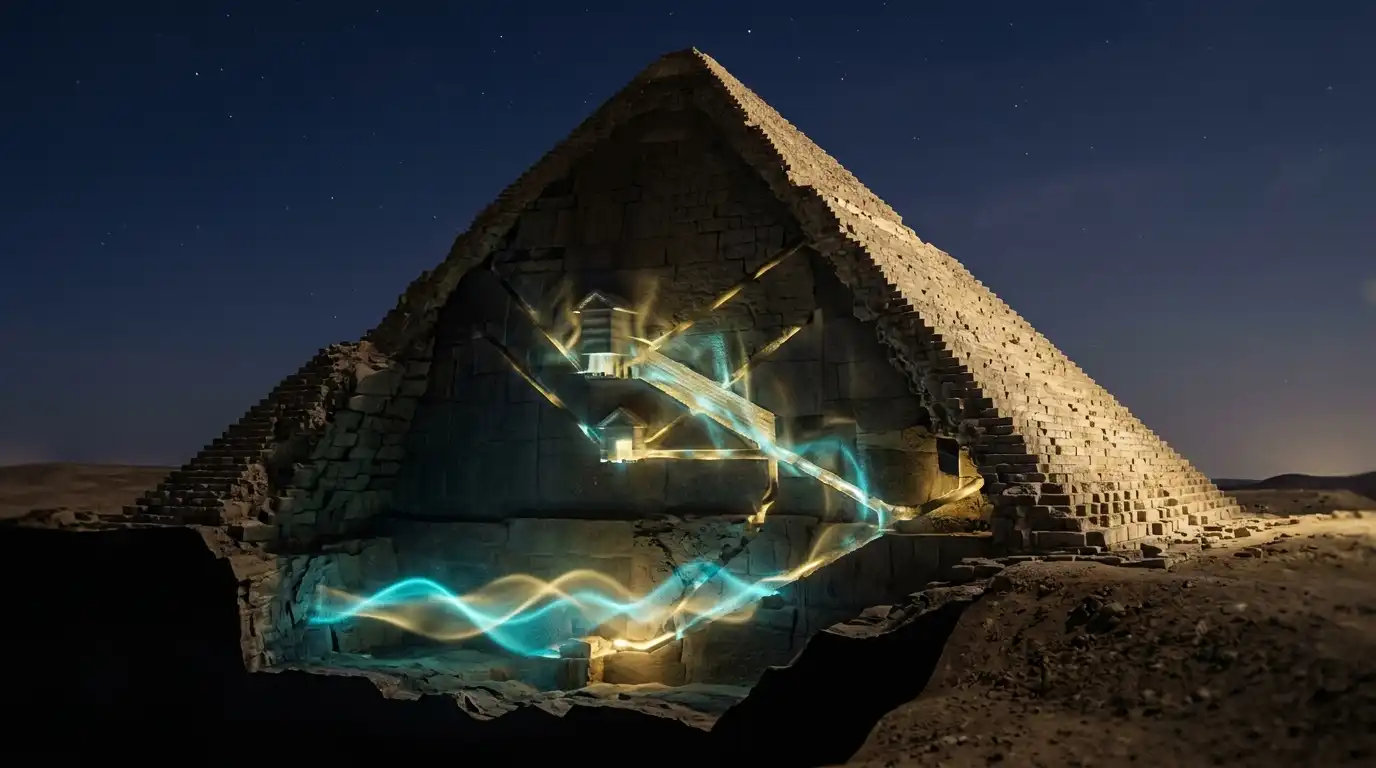
To reduce the monumental architecture of the ancient world to vanity projects of despotic kings is to betray our own intellectual inheritance. The Great Pyramid, the subterranean Hypogeum of Malta, and the stone alignments of the Atlantic seaboard were not built to conquer death through preservation of flesh; they were constructed to master life through the precise physics of frequency, resonance, and material geometry.
By recognizing that matter, sound, and consciousness are interconnected facets of a single vibrational continuum, the modern mind can finally move past the fragmented paradigm of materialist isolation. The megaliths remain silent only until the correct frequency is spoken. When you harmonize your own internal biology through conscious vocal resonance, you re-align with the same universal laws of acoustic pyramid resonance that guided ancient architects—standing not as an observer of dead stone, but as an active, conscious transducer of reality.
Enter the Arcana Visio Sanctum
Deepen your exploration of archetypal systems, esoteric geometry, and sovereign reality design through our dedicated study spaces:
- Arcana Visio Sanctum on Patreon: Join our private study community for practitioners exploring depth psychology, internal alchemy, and reality architecture. Access monthly visual PDF Grimoires, advanced operative protocols, guided somatic audio practices, and ongoing research archives at patreon.com/c/ArcanaVisio.
- NAVIGATOR: 12 Keys to Yourself: Ready to decode the exact financial triad, karmic tail, and core life-purpose codes encoded in your unique natal geometry? Order your personalized, high-ticket Destiny Matrix diagnostic manual on Etsy or explore the complete methodology at arcanavisio.com/navigator/.
- The Arcana Visio Dispatch (Newsletter): Receive our weekly long-form essays, practical somatic protocols, and private releases on depth psychology, cosmic cycles, and consciousness architecture directly to your inbox via arcanavisio.substack.com.
